Birthing ball guide: size, when to start, how to sit and inflate
Size by height, how to sit, how to inflate, what bouncing does, and what the ball won't do: the one page on birthing balls


Someone has told you to get a ball. Your sister, the antenatal class, the midwife at your 25-week appointment. So you've looked, and there are gym balls that cost next to nothing and birthing balls that cost a fair bit more, in two sizes, and every review is arguing about the pump.
Here's the whole thing in one place: what a birthing ball is for, which size, how to sit on it, how to blow it up without losing a weekend to it, and what it will and won't do when labour comes.
Quick answer: A birthing ball is an anti-burst exercise ball you sit on through pregnancy and labour. Get the 65cm up to about 5ft 8in, the 75cm from 5ft 10in, either in between, and check that your hips sit a touch above your knees. Inflate it at room temperature over two days. Use it to sit tall, sway and lean forward. It won't start labour.
Key facts
- Two sizes: 65cm up to about 5ft 8in (1.73m), 75cm from 5ft 10in (1.78m), and either in between, decided by the sit test. The NHS draws its line at 5ft 8in.
- Sitting on it, your knees should be about 10cm lower than your hips (NHS).
- Our ball has a 2000 micrometre wall, is tested to 1000kg, is anti-burst rated and is tested to EN71-3 for the material.
- Inflating it properly takes two days: room temperature, in stages, an overnight rest, then a top-up.
What are the benefits of a birthing ball in pregnancy?
Sitting, mostly. That sounds like nothing, and it's the point.
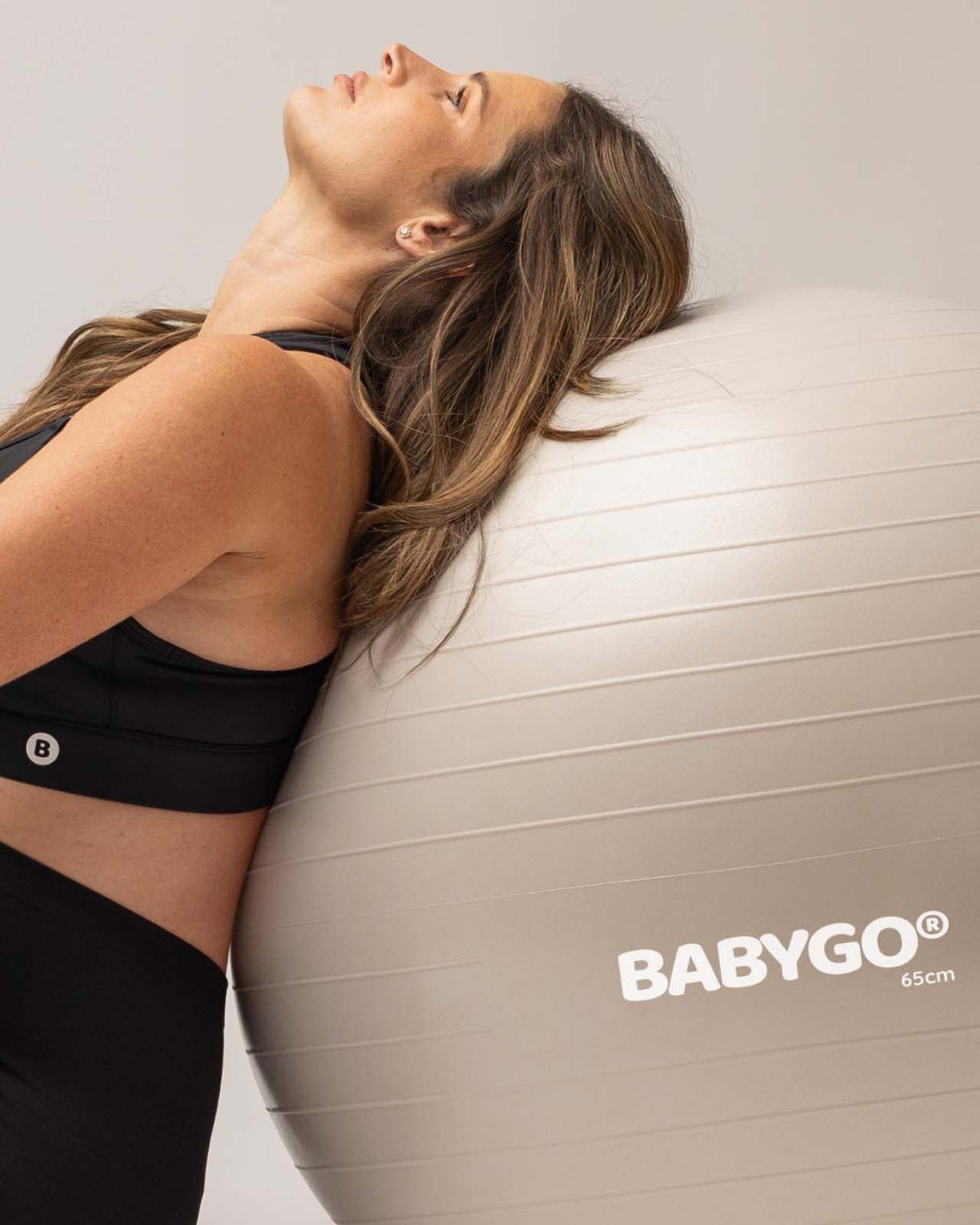
It's hard to slump on a ball. There's no back to lean on, so you sit tall with your pelvis level underneath you, which is the posture every leaflet asks for and nobody manages on a sofa.
Then the moving. Side to side, small circles, a figure of 8: the NHS lists the same three. They keep your hips going as the ligaments around them loosen, which is what helps most with the evening ache. "Back pain" and "third trimester" are the phrases that come up most in our reviews, and that's what people are buying it for.
Then labour. The NHS birthing ball page says a birth ball can help you stay active, ease the pain of contractions, and get you into an upright position that helps bring your baby's head further down into the pelvis.
The catch, in the NHS's own words: only use one in labour if you've practised during pregnancy and feel safe and comfortable on it. So the months of sitting on it are the practice.
What it won't do: fix pelvic girdle pain (it helps some people with PGP and not others), and start labour.

Follow your bump. Tell us your due date and we'll send what to expect each week, plus 10% off your first order.
What does bouncing on a yoga ball do?
Small bounces, feet flat, are movement without effort. Your hips and pelvis move, your legs do a bit of work, and your lower back gets a break from holding the bump still. That's all it is, and that's why pregnant women bounce on them: by 34 weeks a walk has become a waddle and the ball is the easiest way left to keep moving.
Some people find bouncing eases the pressure low in the pelvis in the last weeks. Others find it makes it worse. If it hurts, it isn't helping, so sway instead. And it doesn't shake the baby down or bring on labour. Sitting upright on it can help your baby settle lower into the pelvis over the last weeks, which is a different thing and a slower one.
Bounce safely: hips above knees, both feet flat and about shoulder-width apart, bare feet or grippy socks, never on a wet tiled floor. On laminate, a stability ring under the ball stops it wandering off across the room.
What size birthing ball do I need?
Go by height, then check the fit once it's inflated.
| Your height | Ball size | Fit check |
|---|---|---|
| Up to about 5ft 8in (1.73m) | 65cm | Feet flat, hips a touch higher than your knees |
| 5ft 8in to 5ft 10in (1.73m to 1.78m) | Either: the sit test decides | Same check; the 65cm if you mostly sit, the 75cm if you're long in the leg |
| Taller than 5ft 10in (1.78m) | 75cm | Same check |
Sit on it with your feet flat. Your hips should be a little higher than your knees, about 10cm according to the NHS. Knees up by your hips means it's too small or needs more air. Feet barely touching the floor means it's too big, and too big can't be fixed by letting air out: a soft ball wobbles, and a wobbly ball is the opposite of the point.
The 65cm is what most people under 5ft 8 end up with, the 75cm above it. We make those two sizes and no 55cm; if you're well under five foot the 65cm is still the one. Between 5ft 8 and 5ft 10, sit on one at your antenatal class before you order, or use the size guide.
Is a birthing ball the same as a yoga ball?
Same shape. The difference is the spec, and the only bit of the spec that matters in pregnancy is what happens when it fails. A birthing ball is anti-burst: puncture it and it deflates slowly rather than going off like a balloon under you. The NHS says to look for that whatever you buy.
Ours has a 2000 micrometre wall, it's tested to hold 1000kg, and the material is tested to EN71-3. The NHS's benchmark for a decent ball is one pressure-tested to 300kg, so there's headroom.
Gym ball, yoga ball, Swiss ball, birth ball: all the same object if the rating and the size are right. If you already own one that's anti-burst rated and the right size for your height, use it.
How to sit on a birthing ball
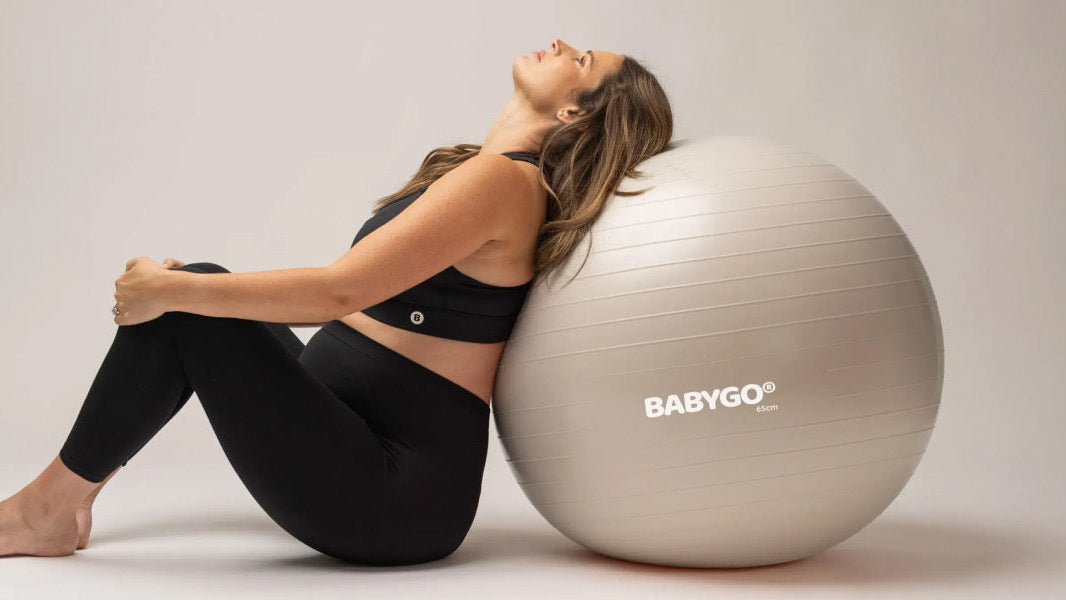
Feet flat, about shoulder-width apart, bare or in non-slip socks. Sit in the middle of the ball, not on the front edge. Hips a touch above your knees, shoulders down, hands on your thighs.
Getting on and off is the least secure moment, especially late on. Put a hand on a wall or a chair and sit down slowly rather than dropping. On a hard floor our stability ring sits under the ball and stops it rolling out from under you; on carpet most people can do without.
Once you're on: side to side, small circles, a figure of 8. Two minutes of each while the kettle boils is a session. The full routine, nine exercises with videos and a trimester note on each, is in our pregnancy ball exercises post.
How to inflate a birthing ball
This is the thing customers ask us about most, and the answer is nearly always the same: you're doing it right, it's slow.
- Unpack the ball and leave it in a warm room for a few hours. Cold material is stiff and fights the pump.
- Pump it to about 80% and put the plug in.
- Leave it for a few hours, or overnight. It will look like it's gone down. It hasn't; the material has stretched.
- Top it up until it's firm but gives a little under your hand. Push the plug all the way in.
- Sit on it and check: hips a touch above knees. Add or let out air.
The hand pump in the box does the job. The electric one does it faster and saves your arms, which is worth it if you're buying at 36 weeks or you plan to deflate the ball to take it to hospital.
Either way, the warm-up and the overnight rest are the material, not the pump. The step by step with pictures is in the complete guide to your BABYGO® birthing ball.

BABYGO® Electric Ball Pump
Plug it in and it does the pumping. Fits the 65cm and 75cm balls and the peanut ball. You can also pick it instead of the hand pump when you order the ball.
£10
Is a birthing ball safe in pregnancy?
Yes, if it's anti-burst, the right size, inflated firm and used on a dry floor. Those four cover nearly everything. Three more from the inbox:
- Push the plug all the way in and check it before you sit. A half-in plug is how balls "go down overnight".
- Bare feet on carpet, grippy socks on laminate, never straight out of the shower on to tiles.
- Keep it away from cat claws, radiator corners and grit on the floor. Anti-burst means it deflates slowly if it's punctured, not that it can't be.
Ask your midwife before you start if you have placenta praevia, any bleeding, high blood pressure or you've been told to rest. Stop and call your maternity unit if you feel dizzy, get pain or bleeding, or your baby's movements change; the NHS movements page says call straight away, even at night.
When should I start using a birthing ball?
Whenever you like, for sitting. Most people bring one in during the second trimester when the lower back and hips start complaining, and it comes into its own from about 32 weeks, when sitting upright and doing slow hip circles eases the pressure in your pelvis and gives your baby room to settle head down.
If you're 37 weeks and have only just found this page, it isn't too late. The NHS wants you to have practised on the ball before you rely on it in labour, and a fortnight of evenings on it is practice. The week by week version is in when to start using a birthing ball.
Using a birthing ball in labour
Ask your midwife whether your unit has balls and whether you can bring your own. If you're bringing yours, it travels deflated with the pump, so set it up early in the day rather than mid-contraction.
Early labour, the latent phase, can take hours or sometimes days, and the NHS says you'll probably be advised to stay at home for it. The ball is the best seat in the house for that: sit and sway through a contraction, kneel and lean forward over it in between. Later on it's the same positions. Upright and forward lets gravity do some of the work.
If you end up lying down, with an epidural say, the ball you want is a peanut ball: it sits between your knees while you're on your side so your pelvis stays open, which matters because lying down is when labour tends to slow. Midwives reach for them for that reason. Plenty of people bring both.
Which birthing ball should I buy?
Ours, obviously. Here's what you're actually getting, so you can hold it up against anything else.

BABYGO® Birthing Ball
Anti-burst, 2000 micrometre wall, tested to 1000kg. In 65cm and 75cm.
From £29 · Sold out
In the box: the ball, a hand pump, a tape measure, two plugs and a plug removal tool, and our 100 page pregnancy book with the exercises by trimester and the birth positions.
You choose the hand pump or the electric pump when you order. One reviewer wrote: "Easy to inflate Nice colour Good pre and post birth Felt confident in the material that it would support weight", which is about the size of it.
Questions we get asked
Why do pregnant women bounce on yoga balls?
Because it's the easiest way to keep the hips moving and the back off the sofa once walking gets hard, and because it's comfortable. It isn't to start labour, whatever it looks like from the outside.
How long should I sit on a birthing ball each day?
There's no set time. Sit on it while it's comfortable and get off when it isn't. Several short goes through the day beat one long stint.
Can a birthing ball bring on labour?
No. Labour starts when your body and your baby are ready, and the NHS says there are no proven ways of starting it yourself at home. What the ball does in the last weeks is keep you upright and comfortable and help your baby's head settle down into the pelvis. There's a separate piece on using the ball in the last weeks.
Do I need a stability ring?
On laminate, tile or wood, most people say yes: it holds the ball still for the sitting down and standing up, and lets you leave it out as a seat. On carpet you can usually do without. It fits both our sizes and sits underneath, nothing to attach.
Can I use the ball after the birth?
Yes, and you probably will more than you expect: bouncing a baby to sleep on it, sitting on it to feed, later as a desk seat. After a c-section, keep to sitting on it until the wound has healed and you feel ready for more; if you're not sure, ask at your postnatal check or ask your midwife.
Next: pick your size with the size guide, then the birthing ball collection has the ball, the ring, the pump and the peanut ball in one place.
Filed under Birthing ball, Pregnancy