

 Lucy Flynn, BABYGO® team
Someone's mentioned a ball. The midwife at your 16-week appointment, the antenatal group chat, your sister. So now you're wondering whether 16 weeks is too early, whether 36 is too late, and what you're meant to do on it in between.
Here's the week by week answer. The short version first, then each stage, then the handful of things that mean stop and ring someone.
Quick answer: You can sit on a birthing ball at any stage for comfort. Most people bring one in during the second trimester, when the lower back and hips start complaining, and it earns its keep from about 32 weeks, when sitting upright and circling your hips eases the pelvis and gives your baby room to settle head down. Starting at 37 weeks is fine. It won't start labour.
Key facts
- The NHS says to only use a birth ball in labour if you've practised on it during pregnancy and feel safe and comfortable on it. The weeks before are the practice.
- Size by height: the 65cm up to about 5ft 8in (1.73m), the 75cm above that, and the NHS draws the line in the same place. Sitting on it, your knees should be about 10cm lower than your hips.
- The NHS's exercise advice in pregnancy is to keep active, not exhaust yourself, and still be able to hold a conversation while you move. After 16 weeks it says not to lie flat on your back for long.
- Whatever week you're at, if your baby's movements slow down, stop or change, the NHS says call your midwife or maternity unit straight away, even in the middle of the night.
On this page
- The first trimester, weeks 1 to 13
- The second trimester, weeks 14 to 27
- Weeks 28 to 36
- 37 weeks onwards
- When to ask first, and when to stop
- Which size, in one line
- Questions we get asked
Can you use a birthing ball in the first trimester?
Yes, for sitting on. Weeks 1 to 13 are mostly tiredness and nausea, and a ball isn't going to fix either. What it does is give you a seat that keeps you upright without effort, which is kinder on a stiff lower back than the sofa and a lot kinder than a desk chair for eight hours.
Keep it to sitting, small side to side sways and getting used to the thing. No vigorous bouncing and no long sessions. The NHS's line for the whole of pregnancy is to keep up your normal activity and not suddenly take up anything strenuous if you weren't active before. The first trimester isn't about preparing for labour. It's about being comfortable.
If you've had any bleeding, you've been told to rest, or you've been through recurrent miscarriage and you're anxious about it, ask your midwife before you start. Not because sitting on a ball is risky, but because they know your pregnancy and we don't.
Nobody needs a ball at nine weeks. Plenty of people like one.

When should I start using a pregnancy ball?
For most people, the second trimester. Weeks 14 to 27 are when the sickness eases, some energy comes back, and the bump starts changing how you stand and sit. It's also when the lower back and the hips first complain, and that's the point people buy a ball.
It's what our own product page says too: sit on it at any stage for comfort, and many people bring one in during the second trimester for lower back and hip relief.
| Weeks | What's going on | On the ball | How long |
|---|---|---|---|
| 14 to 20 | Bump showing, posture starting to shift, the odd twinge low down | Sit tall, feet flat. Side to side sways, small hip circles | About 10 minutes, once or twice a day |
| 20 to 27 | Lower back aches after time on your feet, hips tighten, sitting still gets uncomfortable | Add pelvic tilts and a figure of 8. Swap your chair for half an hour | 10 to 15 minutes, two or three times a day |
| 28 to 36 | Bump heavy, centre of gravity forward, back tired by evening | Sit and sway, circles, and kneel and lean forward over it | 20 to 30 minutes a day, split into a few goes |
| 37 onwards | Pelvic pressure, the waddle, waiting | Upright sitting, the forward lean, and getting used to it for labour | As often as it's comfortable |
Those times aren't rules. The NHS doesn't set one and neither do we: sit on it while it's comfortable and get off when it isn't. Several short goes beat one long stint, and the sessions above are what most people settle into rather than a target.
Little and often is the whole rule, whatever week you're at.
The moves themselves are simple: sway side to side, circle your hips, tilt your pelvis forward and back. The full routine, nine exercises with a trimester note on each, is in our pregnancy ball exercises post, so I won't repeat it here.


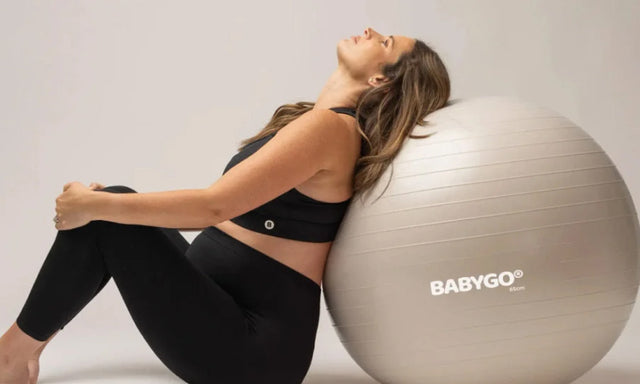
BABYGO® Birthing Ball
Anti-burst, with a 2000 micrometre wall and tested to 1000kg, in 65cm and 75cm. In the box: a hand pump, a tape measure, spare plugs and our 100 page pregnancy book with the exercises by trimester and the birth positions.
Using a birthing ball at 28 to 36 weeks
By the third trimester the ball stops being a nice seat and starts being useful. Your baby is growing fast, your centre of gravity has moved forward, and the natural fix is to lean back to balance it, which is exactly what strains the lower back.
You can't slump on a ball. There's no back to it, so you sit tall with the pelvis level underneath you without thinking about it. That's the posture every leaflet asks for, and this is the stage it starts to matter.
What most people do from 28 weeks is 20 to 30 minutes a day, split into a few goes: sitting and swaying while the telly's on, circles and a figure of 8, and kneeling and leaning forward over the ball when the back's had enough. The forward lean is the one to get used to now, because it's the position you'll want in labour.
That's the shape of the third trimester on the ball: sit, sway, lean.

When should I start bouncing on a ball during pregnancy?
Whenever sitting on it is comfortable, which for most people is the second trimester. Keep the bounces small, feet flat and about shoulder width apart, and stop if it stirs up any pain low in the pelvis. It's movement without effort, not a labour trick. What bouncing does and doesn't do is in the birthing ball guide.
Want the week by week in your inbox? Tell us your due date and we'll send what to expect, what to do and what to sort each week, timed to your dates. 10% off when you're ready.
37 weeks onwards, and whether the ball brings on labour
From 37 weeks the question changes from "does this help my back" to "will this get things going". Two honest sentences on that. Bouncing on the ball doesn't start labour; labour starts when your body and your baby are ready, and nothing you do on a ball reliably changes the date.
What the last weeks on the ball are for is different and slower. The NHS birthing ball page says sitting on it helps you get into a more upright position, which helps bring your baby's head further down into the pelvis, and that it can help you stay active and ease the pain of contractions when the time comes.
So: sit upright, lean forward over it, sway, keep moving. If you're 37 weeks and have only just bought one, that's still worth doing. The NHS wants you to have practised on the ball before you rely on it in labour, and a fortnight of evenings on it is practice.
In labour itself the ball is the seat for the early hours at home, and later the thing you lean over between contractions. Positions in labour, and when a peanut ball does the job instead, are in the birthing ball guide. Ask your midwife whether your unit has balls and whether you can bring your own.

BABYGO® Electric Ball Pump
If you're starting late, this is the one. It does the pumping for you and fits the 65cm and 75cm balls and the peanut ball. The ball still wants to reach room temperature and be topped up the next day; the pump takes the effort out, not the wait.
When should you not use a birthing ball?
Ask your midwife before you start if you have placenta praevia, any bleeding, high blood pressure that's being watched, severe pelvic girdle pain, or you've been told to rest or restrict activity. The ball isn't dangerous in itself. The point is that your midwife knows why you've been told what you've been told.
Get off it and call your maternity unit if you feel dizzy or faint, you get pain or bleeding, there's sudden swelling, or your baby's movements change. The NHS movements page is blunt about the last one: call straight away, don't wait until the morning.
And the boring ones: a dry floor, bare feet or grippy socks, the plug pushed all the way in, and a hand on something solid when you sit down or stand up. Getting on and off is the least secure moment, and it gets less secure every week.
Which size, in one line
The 65cm up to about 5ft 8in, the 75cm if you're taller, and if you're between the two the sit test decides: feet flat, hips a touch above your knees. The chart and the sit test are on the size guide, and the inflation routine is in the birthing ball guide.
Questions we get asked
When should I get a birthing ball?
When you'd use it, which for most people is the second trimester. If you're buying ahead, aim for around 20 weeks: inflating it properly takes two days, and you want it sat in the corner ready for the first evening your back complains, not still in the box.
How many weeks pregnant can you use a birthing ball?
Any week. What changes is what you do on it: sitting early on, sways and circles in the second trimester, the forward lean in the third.
Is it safe to bounce on a birthing ball at 30 weeks?
For a straightforward pregnancy, yes. Small bounces, feet flat, hands on your knees. If it stirs up pain low in your pelvis, sway instead.
When is it too late to start using a birthing ball?
It isn't. Plenty of people find the ball at 37 or 38 weeks and use it every day from then on for sitting, leaning and swaying. The NHS asks that you've practised on it before you use it in labour, and a couple of weeks of evenings is enough for that.
Can I use a birthing ball as a desk chair?
For stretches, yes, and lots of people do from the second trimester on. Half an hour at a time rather than the whole day: your back and core get a break from holding you upright, and then you get a break from the ball. On a hard floor a stability ring stops it wandering off when you stand.
Next: pick your size with the size guide, then the birthing ball collection has the ball, the pump, the ring and the peanut ball in one place.
This is general guidance from the BABYGO® team, not medical advice. Your midwife or GP knows your pregnancy; ask them if anything here doesn't fit your situation.


