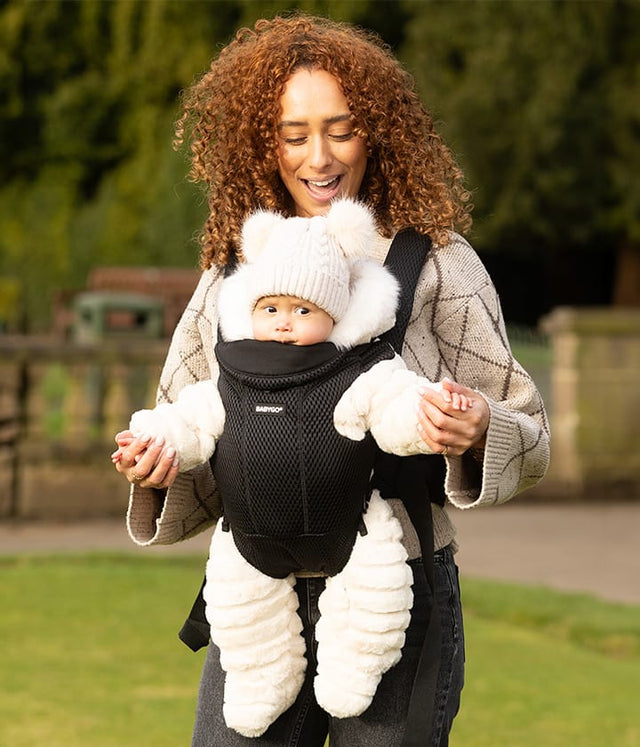
A breathable baby carrier for newborns to toddlers
Our AirMesh™ Baby Carrier is the one carrier we make, in four colours. The whole body panel is an open mesh, so heat escapes instead of building up between you, which you'll notice under a winter coat as much as on a warm day.
It carries your baby three ways: facing in, facing out once they can hold their head up, and on your back from 6 months. It fits babies from 3.2kg to 14kg (7lb to 30.8lb), with leg openings and a head rest that adjust as they grow.
Padded shoulder straps share the weight and the waist belt takes the rest, so tighten the belt first, then the straps. It all adjusts quickly, so you can hand over to your partner, and it complies with EN 13209-2:2015, the safety standard for soft baby carriers.
Questions, answered.
From what age can I use a baby carrier?
Ours fits from the newborn weeks, once your baby weighs 3.2kg (7lb), up to 14kg (30.8lb). For a newborn, position matters more than age: high enough on your chest to kiss, face clear and turned to the side, and chin off their chest so the airway stays open.
How do I carry my baby safely?
Follow TICKS: Tight, In view at all times, Close enough to kiss, Keep chin off the chest, Supported back. Your baby should sit in a supported squat, knees higher than their bottom and thighs supported to the knee, in an M shape. You should be able to see their face at a glance without moving any fabric.
Which carry position should I use?
Facing in is the one for newborns and sleepy days, with their face right where you can see it. Facing out suits a baby who can hold their head up and wants to look around, and the back carry is for babies from 6 months.
Can I use a carrier after a C-section?
Usually, but wait until you're comfortable and ideally until after your six-week check. The waist belt sits close to where a C-section incision is, so wearing it higher, above the incision, helps a great deal. If anything pulls at the wound or feels sharp, stop and check with your midwife or GP.
What's the difference between a carrier and a sling?
A carrier like ours is structured, with buckles, padded shoulder straps and a waist belt, so it's quick to put on and adjust. A sling or wrap is one long piece of fabric you tie round yourself, which is more flexible once you've learned it but takes practice.