
Updated 16 September 2026 by the BABYGO® team.
It's bedtime, the thermometer on the shelf says 17, and there are two sleeping bags in the drawer. Which one, and what goes underneath? That is the whole question, and it has a short answer once you know the room temperature.
TOG is just a warmth rating. The higher the number, the warmer the bag. You pick the TOG from the temperature of the room your baby sleeps in, measured with a thermometer rather than guessed, and you pick the layers underneath from the same number. Not the weather outside, not the month.
Quick answer: most UK bedrooms sit at 16 to 20°C at night, which is the range the NHS and the Lullaby Trust recommend, and that is 2.5 TOG territory: a 2.5 TOG bag over a sleepsuit, with a long-sleeve vest added when the room is at the cold end. Warmer than 21°C, drop to a 1.0 TOG and a short-sleeve vest. Colder than 16°C, go up to 3.5 TOG and try to warm the room.
What should baby wear to sleep tonight?
Type in the room temperature and your baby's age. You'll get the TOG, the layers underneath, and the bag that matches.
Works from the NHS and Lullaby Trust room temperature guidance (16 to 20°C). It is a starting point, not a rule: babies differ, so check the chest or the back of the neck once they are down.
Baby sleeping bag TOG chart (room temperature to TOG to layers)
| Room temperature | TOG | Underneath the bag | When you'll see it in the UK |
|---|---|---|---|
| 24°C and above | 0.5 TOG | Short-sleeve vest, or just a nappy from 27°C | Heatwaves, loft bedrooms in July, holidays |
| 21 to 23°C | 1.0 TOG | Short-sleeve vest | Most bedrooms from June to early September |
| 18 to 20°C | 1.5 TOG (or 2.5 TOG with lighter layers) | Short-sleeve vest and a sleepsuit in a 1.5; sleepsuit only in a 2.5 | Spring and autumn, a heated house in winter |
| 16 to 17°C | 2.5 TOG | Long-sleeve vest and a sleepsuit | Most of the year in most UK homes |
| Under 16°C | 3.5 TOG | Long-sleeve vest and a sleepsuit, and warm the room if you can | Old houses in deep winter, unheated nurseries |
Two bags cover almost every night of a UK year: a 2.5 TOG for autumn to spring and a 1.0 TOG for summer. The 1.5 is the one to add if your nursery hovers at 18 to 20°C for months at a time, which a lot of newer flats do. The 0.5 and 3.5 are for the extremes.
The one thing not to do at any TOG is add a blanket on top. The bag is the bedding. If the room is cold, change the layers underneath or the TOG, not the top.
0.5 TOG for heatwaves and hot rooms (24°C and up)
The lightest bag we make, in the same 95% organic bamboo as the rest of the range, which matters more at this end because bamboo lets heat out rather than trapping it.
Over 24°C, a short-sleeve vest underneath is plenty. From about 27°C, a nappy and the bag on its own. A fan in the room, pointed at the wall rather than the cot, brings the number down without a draught on the baby.

BABYGO® Baby Sleeping Bag, 0.5 TOG
Sizes 0-9M, 9-18M and 18-36M. Two-way zip so a nappy change happens from the feet end without taking the bag off.
1.0 TOG for a typical UK summer bedroom (21 to 23°C)
This is the summer bag for most of the country. Short-sleeve vest underneath and that's it. If the room drops to 21°C towards morning, a light sleepsuit instead of the vest is fine, or hold your nerve: a baby who is warm enough at bedtime is usually still fine at 5am, and hands that feel cool are normal.

BABYGO® Baby Sleeping Bag, 1.0 TOG
Sizes 0-9M, 9-18M and 18-36M. Washes at 30 degrees, which you will be doing a lot of in summer.
1.5 TOG for spring, autumn and warm flats (18 to 20°C)
The in-between bag. A 1.0 feels too light at 18°C and a 2.5 can feel too much at 20°C, and if your nursery lives in that band, the 1.5 stops you second-guessing every night. Short-sleeve vest and a sleepsuit underneath, or a long-sleeve vest on its own at the warmer end. We make it in white and in olive.

BABYGO® Baby Sleeping Bag, 1.5 TOG
Olive in 0-9M and 9-18M; white in 0-9M, 9-18M and 18-36M.
2.5 TOG, the bag most UK babies sleep in (16 to 20°C)
If you only buy one, buy this one. The NHS and the Lullaby Trust both put the ideal room at 16 to 20°C, and a 2.5 TOG bag is built for exactly that range. At 16 or 17°C put a long-sleeve vest and a sleepsuit underneath.
At 18 to 20°C a sleepsuit on its own is usually right, and on a mild night a long-sleeve vest alone. It is our best seller in the range for a reason, and it comes in white and in two prints, Tulip and Midnight Moon.

BABYGO® Baby Sleeping Bag, 2.5 TOG
Sizes 0-9M, 9-18M and 18-36M. 95% organic bamboo shell, polyester fill, 30 degree wash.
See the 2.5 TOG in white · Tulip print · Midnight Moon print
3.5 TOG for cold rooms and deep winter (under 16°C)
For the houses that never quite get warm: stone cottages, big Victorian bedrooms, anywhere the heating goes off at ten. Long-sleeve vest and a sleepsuit underneath.
If you are reaching for the 3.5 most nights, it is worth a cheap room thermometer and a look at whether the room can be kept nearer 16°C, because the guidance is about the room as much as the bag. And still no blanket on top.

BABYGO® Baby Sleeping Bag, 3.5 TOG
White, grey, Tulip and Midnight Moon. Sizes 0-9M, 9-18M and 18-36M in white and grey; 0-9M and 9-18M in the prints.
Which sleeping bag size fits
Go by the neck and the chest, not the age on the label. The bag has to sit close enough at the neck that your baby cannot wriggle down inside it, and roomy enough at the hips and feet to kick. If you can pull the neck opening up over the chin without effort, it is too big for now.
| Size | Chest | Length | Neck width | Rough guide |
|---|---|---|---|---|
| 0-9M | 31cm | 70cm | 10cm | From when the neck fits closely (a few weeks for smaller newborns) to about 9 months |
| 9-18M | 35cm | 90cm | 12cm | Sitting and crawling babies |
| 18-36M | 38cm | 102cm | 12cm | Toddlers, and the cot to bed move |
A newborn goes in a sleeping bag as soon as the neck fits. Before that, a light swaddle or a sheet tucked in below the shoulders, with feet at the foot of the cot.
How a sleeping bag should fit
Neck snug, armholes close but not tight, room to kick. That is the whole fitting check, and it is worth doing again every couple of months because they grow into the next size faster than you expect.
The two-way zip on ours runs from the feet end, so a 3am nappy change is unzip, change, zip, with the bag still on and the baby still half asleep. Poppers at the shoulder for getting it on in the first place.
Why a sleeping bag rather than a blanket
Blankets get kicked off, then pulled up over faces, then kicked off again. A bag can't be kicked off and can't ride up over the head if the neck fits, which is why the Lullaby Trust lists a lightweight, well-fitting sleep bag as one of the two safe options for bedding.
It also keeps the warmth constant through the night, so you are not doing the 2am blanket check. No duvets, no pillows, no cot bumpers, nothing loose in the cot at any age.
How to tell if your baby is too hot or too cold
Feel the chest or the back of the neck. Not the hands, not the feet: those run cool on most babies and tell you nothing. Hot or sweaty at the neck means take a layer off. Cool at the chest means add one, or go up a TOG. A room thermometer takes the guesswork out; a decent one costs less than a takeaway and sits on the shelf for years.
Three more from the NHS worth knowing: no hats indoors, ever, even for a nap; if your baby has a temperature, fewer layers not more; and when you come in from the cold, take the outdoor layers off straight away even if it wakes them.
Sources: The Lullaby Trust on room temperature and the NHS guidance on safer sleep.
What to put underneath
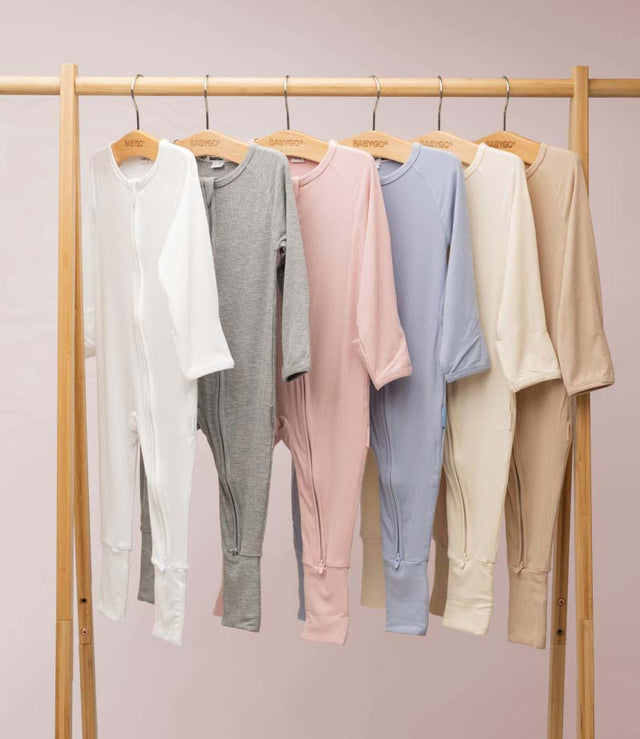
A vest and a sleepsuit are the two layers you're choosing between. Our long-sleeve bodysuits and short-sleeve bodysuits are the same bamboo as the bags, so the whole outfit breathes the same way, and the zip sleepsuits open from the ankle for the same 3am reason. Socks are not needed inside a bag. Nothing with a hood.
Want tonight's answer sent to you when the seasons change? Get 10% off your first BABYGO® order, what to put them in as the weather turns, and the room by room safety list when they start moving.
Questions we get asked
What TOG sleeping bag for a 20 degree room?
2.5 TOG with a sleepsuit and no vest, or 1.5 TOG with a short-sleeve vest and a sleepsuit. Both are right at 20°C; it depends which bag you own.
Is a 2.5 TOG too hot for summer?
Above 21°C, yes. A 2.5 is built for 16 to 20°C. In a July heatwave you want the 1.0 or the 0.5. The trap is a warm evening followed by a cool night: if the room is 22°C at bedtime but drops to 18°C by 3am, a 1.5 with a vest and sleepsuit covers both ends better than a 1.0 does.
What temperature is a 1.5 TOG sleeping bag for?
18 to 20°C, with a short-sleeve vest and a sleepsuit underneath. At 21°C it still works with just a vest.
Can a newborn wear a sleeping bag?
Yes, from the point the neck fits closely. Our 0-9M has a 10cm neck, a 31cm chest and is 70cm long, so a small newborn may need a few weeks. Try it on: if the neck sits close and the arms are not restricted, they are ready. Until then, a light swaddle or a tucked sheet.
What should my baby wear under a 3.5 TOG?
A long-sleeve vest and a sleepsuit. That's the most anyone should put under any bag. If it still feels like too little, the room is the problem and the fix is a thermometer and a heater on a timer, not a blanket on top.
Do I need a 0.5 TOG at all in the UK?
Only if your bedroom goes over 24°C, which for most houses is a handful of nights a year. Loft rooms, south-facing flats and holidays abroad are the exceptions. Everyone else gets through summer on a 1.0.
Shop the range
Every TOG, every size, in the same organic bamboo: see all baby sleeping bags. If you are working out the layers as well, the sleepsuits and bodysuits are the other half of the answer.
General guidance from the BABYGO® team based on NHS and Lullaby Trust advice, not medical advice. If your baby is unwell or you are unsure, talk to your midwife, health visitor or GP.


