




 Lucy Flynn, BABYGO® team · Updated
You're 39 weeks and a bit. Every message on your phone says "any news?". You've had the curry, done the walk round the block twice, and now you're looking at the ball in the corner and wondering whether bouncing on it might get things moving.
We sell the ball, so you'd expect us to say yes. The honest answer is below, then the useful part: what the ball actually does in the last weeks, the positions worth your time, what a sweep is, and when to ring the midwife.
Quick answer: No exercise reliably starts labour, and the NHS says there are no proven ways to bring it on at home. What a birthing ball does is help you sit upright and lean forward, which encourages your baby's head down into the pelvis and makes the waiting more comfortable. Past 39 weeks, the thing to ask your midwife about is a membrane sweep.
Key facts
- The NHS: "There are no proven ways of starting your labour yourself at home."
- A membrane sweep is usually offered after 39 weeks. If it doesn't work you may be offered another, or induction.
- Induction is offered if you haven't gone into labour by 41 weeks.
- Upright, forward-leaning positions on the ball help bring your baby's head further down into the pelvis (NHS).
- Call your maternity unit urgently if your waters break, you have any bleeding, or your baby is moving less than usual.
Does a birthing ball help induce labour?
Not in the sense you mean. Labour starts when your body and your baby are ready, and nothing you do on a ball moves that date. The NHS is blunt about it on its inducing labour page: there are no proven ways of starting your labour yourself at home, and that covers the ball as much as it covers the curry.
What the ball does do is worth having. Sitting upright on it with your knees below your hips, and kneeling to lean forward over it, gives your baby room and lets gravity bring the head further down into the pelvis. That's the NHS's line, not ours. A baby who's low and well positioned isn't a labour that's started, but it's where you'd want them when it does.
And it makes the last weeks easier to sit through, which by 40 weeks is not nothing. Sofas have stopped working. The ball still does.
So use it. Just don't use it in the hope of a date.

Birthing ball positions for the last weeks
These aren't exercises. Nothing to count, nothing to hold for three seconds. They're the ways of sitting and leaning that keep you upright and comfortable, with a note on what each is for. The nine proper exercises, with videos, are in our pregnancy ball exercises post, and you don't need any of them for this.
| Position | How | What it's for |
|---|---|---|
| Sitting tall | Feet flat, hips above knees, hands on your thighs. Watch telly like this. | Posture, your back, and keeping your baby upright in the pelvis |
| Hip circles and figure of 8 | Slow circles one way, then the other, then a figure of 8. Two minutes each. | Loosens the hips and pelvis |
| Side-to-side sway | Sway as if you're on a boat. Shoulders loose. | Eases pelvic pressure; the contraction position later |
| Gentle bounce | Small, feet flat, hands on your knees. Stop if it hurts. | Keeps you moving when walking's hard |
| Forward lean | Kneel on a cushion, arms and chest over the ball, rock gently. | The forward-leaning position that helps the head down; the labour favourite |
| Ball at the desk | Half an hour on the ball instead of the chair. | Posture without trying |
How long for: as long as it's comfortable. There's no number of minutes that starts labour, so there's no target to hit. If your pelvis or back starts to ache, get off.
A few things to keep to, because the last weeks are when people get careless: hips above knees (add air if you've sunk into it), bare feet or grippy socks, something to hold when you sit down and stand up, and if your midwife has told you to rest, ask before any of this.
The last weeks, week by week
If you like a plan, this is ours. It's short because the honest plan is short.
| Week | On the ball | Off the ball |
|---|---|---|
| 37 to 38 | Evenings on it instead of the sofa. Practise the forward lean so it's familiar. | You're full term from 37 weeks. There's nothing to bring on. |
| 39 | The same. Comfort is the only target. | Ask about a membrane sweep at your appointment; the NHS says it's usually offered after 39 weeks. |
| 40 | Sway, circles and the forward lean through any tightenings. | If the ball is coming to hospital, it travels deflated, so pack the pump. |
| 41 and after | Nothing changes. The ball doesn't know the date. | Induction is offered if you haven't gone into labour by 41 weeks. Your midwife will talk it through. |

BABYGO® Birthing Ball
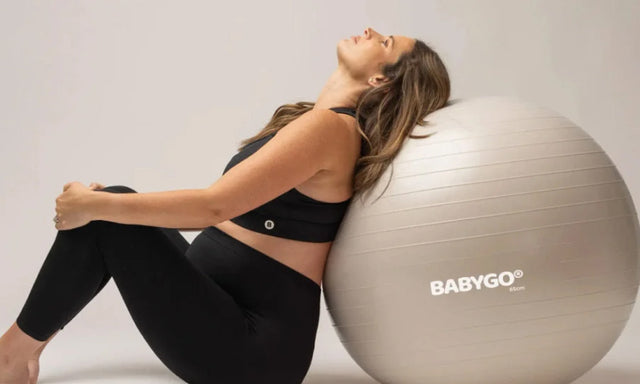
If you're this close and haven't got one: anti-burst, tested to 1000kg, in 65cm and 75cm. 65cm up to about 5ft 8in, 75cm above. Pick the electric pump option, because inflating it properly takes two days and you haven't got the arms for it at 39 weeks.
How to induce labour naturally, and what the NHS says
Everyone has a thing that worked for them. A hot bath, the curry, pineapple, raspberry leaf tea, sex, a long walk, bouncing. Everyone goes into labour eventually, and whatever they did last gets the credit.
The NHS puts it plainly: there are no proven ways of starting labour at home, and it names hot baths, certain foods and drinks, sex and herbal supplements as the ones people try without evidence behind them. It also warns that herbal supplements could be harmful to you or your baby, so if you're tempted by the tea or the capsules, ask your midwife before you buy them.
The ones that are at least good for you while you wait: walking, sitting upright on the ball, leaning forward over it. None of them starts labour. All of them keep you more comfortable and keep your baby well positioned, which is the most anyone can honestly promise you.
Your 40-week ball plan: three exercises a week from week 20. Tell us your due date and we'll send what to expect, what to do and what to sort each week. 10% off when you're ready.
What is a membrane sweep?
A sweep is the one thing on this page that's actually meant to start labour, and it's the one you can't do yourself.
At an antenatal appointment your midwife or doctor does an internal examination and sweeps a finger around your cervix, separating the membranes around your baby from it. That's the whole procedure, and you go home afterwards. You'll hear it called a cervical sweep too; same thing.
The NHS says it's usually offered after 39 weeks. Some people find it uncomfortable or painful, some barely notice it. You can get cramping and some vaginal bleeding afterwards, so take a pad and don't plan much for the rest of the day. If labour doesn't start, you may be offered another sweep, or induction.
You can say no to a sweep. You can also ask for one if nobody has mentioned it and you're past 39 weeks.
The difference between a sweep and an induction
A sweep is the nudge. Induction is the medical way of starting labour when it hasn't started on its own, and the NHS offers it if you haven't gone into labour by 41 weeks, or earlier if there's a reason to. It usually means a hormone pessary, gel or tablet, sometimes having your waters broken, and sometimes a hormone drip to keep things going. Your midwife will talk you through it, and the NHS induction page is the one to read the night before.
When to call the midwife
Whatever you're doing on the ball, these come first. Straight from the NHS signs of labour page.
Call your midwife or maternity unit urgently if:
- your waters break
- you have vaginal bleeding
- your baby is moving less than usual
- you're less than 37 weeks pregnant and think you might be in labour
- any of your contractions last longer than 2 minutes
- you're having 6 or more contractions every 10 minutes
Call 999 if you think your baby is coming now and you have a strong urge to push.
Short of that, ring the unit for guidance if you think you're in labour or your contractions are coming every 5 minutes or more often. Early labour, the latent phase, can take hours or sometimes days, and you'll probably be told to stay at home. The ball is the best seat in the house for it.
Reduced movements get their own line because people wait until morning. Don't. The NHS movements page says call straight away, even in the night.
In labour, the ball and the peanut ball
The NHS says only use a birth ball in labour if you've practised on it in pregnancy and feel safe on it, which is the other reason to spend these weeks sitting on it. In labour it can help you stay active and upright and ease the pain of contractions: sit and sway through them, kneel and lean forward over it in between. The NHS birthing ball page has the positions.
If you end up on the bed, with an epidural or because you're worn out, a birthing ball is no use lying down. That's the peanut ball's job: it sits between your knees while you lie on your side and keeps your pelvis open, which is exactly when labour tends to slow. Midwives use them for that reason. Ask whether your unit has one.

BABYGO® Peanut Ball for Labour
For the lying-down part of labour, and for side-lying feeds after. one size (50cm), with a foot pump, spare plugs and our labour book in the box. Inflate it well before your due date so it's packed and in the car, not a job for early labour. 90 reviews at 4.9 out of 5.
Questions we get asked
How many sweeps can you have?
The NHS doesn't put a number on it. If the first doesn't start labour you may be offered another sweep or induction, and how many your unit will do before moving on is a question for your midwife.
Does a sweep hurt?
Some people find it uncomfortable or painful, some barely notice it. The NHS says you can get cramping and some vaginal bleeding afterwards, so take a pad and keep the afternoon quiet.
How long should I bounce on the ball to bring on labour?
No length of bouncing starts labour, so there's no answer to give you. Bounce or sway for as long as it's comfortable and get off when it isn't.
Can I use the ball to bring on labour at 37 weeks?
At 37 weeks you're full term, but there's no way to bring labour on with a ball and no reason to try to hurry it. Sit on it for comfort and for your baby's position. The NHS doesn't usually offer a sweep until after 39 weeks, and induction is offered at 41 weeks if you haven't gone into labour, so those are the dates that matter, not anything you do in the living room.
Is bouncing on the ball safe when I'm overdue?
Yes. Small bounces with your feet flat, hips above your knees, on a dry floor, the same as any other week. Being past your date doesn't make the ball less safe; what it changes is that your midwife will be talking to you about a sweep and, from 41 weeks, about induction.
Next: if you're choosing a ball this late, the size guide takes a minute and the birthing ball collection has the ball, the pump and the peanut ball together; for the ball itself, our birthing ball guide is the long version.
This is general guidance from the BABYGO® team, not medical advice. Your midwife or GP knows your pregnancy; ask them if anything here doesn't fit your situation.


