


Magnetic cupboard locks: how they work and how to fit them
Leah explains how magnetic cupboard locks work, how to fit them so the pads actually hold, and which doors need a strap instead


Somewhere between crawling and walking, the kitchen cupboards become the best toy in the house. The under-sink one especially, because that's where the dishwasher tablets live.
You've probably looked at the clip-on plastic locks that hang off the outside of every door and thought, no. Magnetic locks are the tidy answer. They sit inside the cupboard, nothing shows, and you open them with a magnetic key held against the front.
They're also the product we get the most fitting questions about, so this is the honest version, including the cupboards they won't work on.
Quick answer: Magnetic cupboard locks stick inside the door with 3M pads, so nothing shows outside and there's no drilling. A magnetic key held against the front releases the catch. Do the under-sink, cleaning and bin cupboards first, clean the surface properly, give the adhesive 24 hours before you test it, and use straps for the fridge, oven and anything that won't line up.
Key facts
- A box is 10 locks, 10 catches, 2 magnetic keys, the applicator and 8 corner protectors. Most kitchens use six to ten locks.
- They fit with 3M adhesive pads. No screws, no drilling, though screws are in the box if you want a permanent fix.
- Press for 5 minutes, then leave 24 hours before you test a lock with any force. Testing early is how most pads get pulled off.
- Replacement keys are available, and every lock has an off position so cupboards open normally when there are no children about.
How do magnetic cupboard locks work?
Two parts. The lock is a small sprung hook that sticks to the inside of the cupboard frame. The catch sticks to the inside of the door. Close the door and the hook drops over the catch, so when the door is pulled it holds.
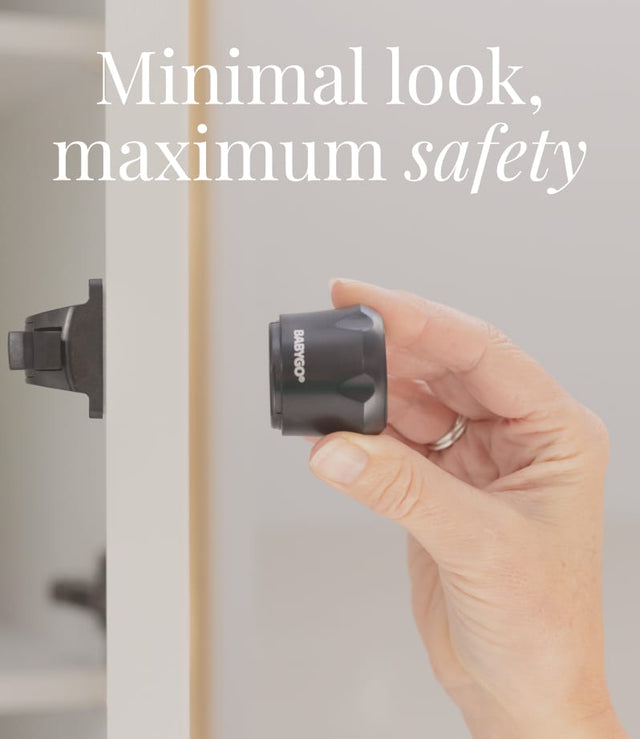
The key is a round magnet. Hold it against the outside of the door, roughly where the lock sits behind, draw it downwards, and the magnet lifts the hook clear. Open the door, take the key away, and next time the door closes it locks itself again. Nothing on the outside, no visible catch, no holes.
The bit people miss is the off position. Flip the hook up and the lock stays open, so the cupboard works like a normal cupboard. Flip it down and it's armed again. That's what makes them work at a grandparent's house, where nobody wants to hunt for a key to get the mugs out on a Tuesday when the children aren't there.

10% off your first order at BABYGO®. Pop your email in and the code is on its way.
Which cupboards need a child lock, and which can stay open
Not all of them. Locking every door in the kitchen makes cooking a chore and gives a toddler nothing to do, which is how you end up with a child hanging off the oven door instead.
The ones that matter: the under-sink cupboard, wherever the cleaning stuff lives, the bin drawer, the cutlery drawer, and any low cupboard with glass, heavy pans or the good plates. Then leave one or two low cupboards open on purpose with plastic bowls and wooden spoons in them. It sounds soft. It takes a surprising amount of pressure off the rest.
Count those up and most kitchens land between six and ten locks, which is why the box has ten. Some doors need a different fixing altogether.
| Door or drawer | What to use | Why |
|---|---|---|
| Kitchen cupboards and drawers with a flat inside face | Magnetic lock | Hidden, nothing on the outside, switches off when the children aren't there |
| Fridge, freezer, oven door, bin, toilet seat | Safety strap | Metal, curved, or no inside frame to fix a lock to. A strap sticks across the outside and trims to length |
| Double doors with a gap in the middle, or a door that hangs on the wonk | Safety strap | A magnetic catch has to line up within a few millimetres. A strap doesn't care |
| Room doors (bathroom, utility, garage) | Door handle lock | Slides over a lever handle so it can't be pushed down. Two per pack, no drilling, won't fit round knobs |
| The oven | Oven lock | Holds the door shut against small hands. Fit it to a cold oven and leave it 24 hours |
How to fit magnetic cupboard locks without drilling
Read this bit even if you never read instructions. The pads are strong once they've cured, and there's no moving a lock that's stuck in the wrong place.
Prep the surface first
When a pad lets go, it's nearly always one of three things: grease, testing too soon, or a door that doesn't close flush. Kitchen cupboards carry a film of cooking grease you can't see.
Wipe the spot with something that leaves no residue (an alcohol wipe or surgical spirit is ideal; anything with polish or scent in it isn't), then let it dry completely. Don't fit onto a warm surface and don't fit onto fresh paint.
The eight steps
- Clean and dry the spot inside the cupboard where the lock and the catch will go.
- Clip the lock and the catch into the applicator (the tool in the box). It holds them the right distance apart, so you don't have to measure.
- Peel the backing off the catch and press it to the inside of the door. It can sit upright, sideways or pointing down depending on the cupboard; on a high cupboard it goes on pointing down, so the key works from below.
- Peel the backing off the lock, close the door with the applicator still attached, and press the door firmly against the frame for a good five minutes so the pad bonds.
- Open the door and unclip the applicator from the catch.
- Press the hook down to arm the lock. Close the door and it should hold.
- Hold the key against the outside of the door where the lock sits behind, and draw it down. The door releases.
- Stick one of the little placement stickers on the front if you want a marker for where the key goes. After a week you won't need it. Some people just listen for the click.
Then leave it alone overnight. The tape holds after five minutes but it takes 24 hours to cure, and a toddler testing it at hour three is how pads come off.
Drawers work the same way with one extra step: measure the depth of the drawer front first and use that to place the lock on the frame above, so the catch on the back of the front lines up. Shallow fronts are the awkward ones. One reviewer found the catch needs about an inch of room each way, and their drawers didn't have it.

BABYGO® Magnetic Child Safety Locks
The hidden fixing for kitchen cupboards and drawers. 10 locks, 10 catches, 2 keys, the applicator and 8 corner protectors, with optional screws in the box. Switches off when the children go home.
£22
Magnetic locks not working? Check these before you rip one off
| What's happening | Usual cause | Fix |
|---|---|---|
| Door opens as if there's no lock | Alignment. The hook is missing the catch, usually because the door sits a few millimetres proud or hangs unevenly (wide doors are the usual culprits) | Close the door slowly and watch where the hook lands. Adjust the hinge so the door sits flush, or use a strap on that one |
| Lock comes away from the frame | Grease, residue, or tested before the 24 hours were up | Clean properly, use a spare pad from the box, press for five minutes, leave it overnight. For a cupboard that gets yanked daily, use the screws |
| Key won't release it | The mounting cap is still on the key, the door is very thick, or a metal handle sits right over the lock | Unscrew the key from its cap. Move the lock away from metal handles. One reviewer's key worked through a wooden door about 25mm thick; much beyond that, use a strap |
| Lock won't hold on any cupboard | The hook is flipped up into the off position | Flip it down. Easily done after a visit with it switched off |
When magnetic locks don't suit, and what to use instead
I'd rather tell you now than have you find out with a stuck pad. Magnetic locks need a flat inside surface to bond to, a door that closes flush, and a door the magnet can reach through. Lose any one and you're fighting it.
Very thick or solid doors. The key has to pull the hook through the door. Standard kitchen doors are fine. Chunky solid oak fronts or thick moulded panels put the lock too far from the key, and no amount of wiggling fixes physics.
Metal and appliances. A fridge, freezer or oven door has no inside frame to fix to, and a magnet doesn't behave itself near steel.
Curved, ribbed or heavily textured fronts. The pad needs flat contact across its whole face. Shaker doors are fine because the lock goes on the flat inner face; a curved sideboard door or a rattan front isn't.
Doors that don't meet the frame. Double doors with a gap in the middle, an old sideboard, a door that's dropped on its hinges. The catch has to meet the hook within a few millimetres, every single time.
The fix for all four is the same: a safety strap. It sticks across the outside, so it's visible, but it trims to length, goes round handles and is tested to 30kg of pull, which is more than a toddler can manage.
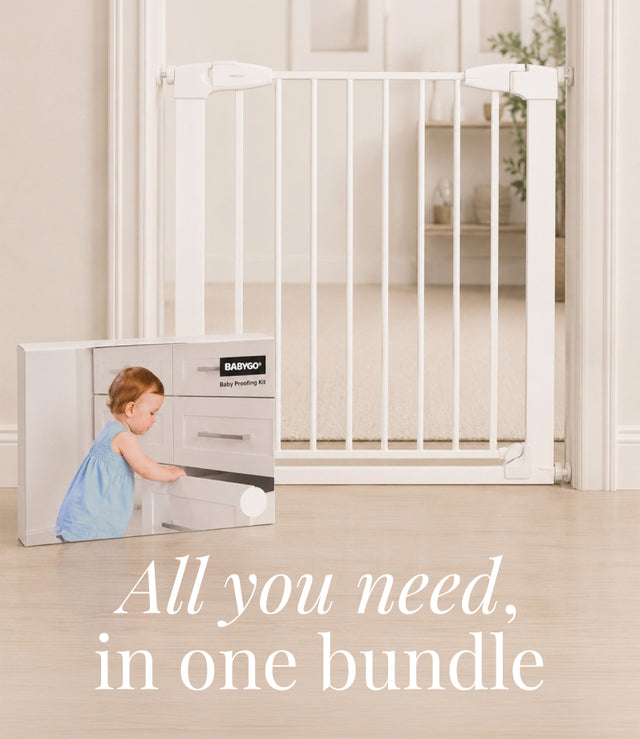
Most houses end up with magnetic locks on the kitchen cupboards and a handful of straps on the awkward stuff. If you're starting from nothing, the baby proofing kit has eight locks and four straps in one box, plus corner protectors, door stops, socket covers and the oven lock.

BABYGO® Child Safety Straps
For the fridge, the oven, the bin, the toilet seat and any door a magnetic catch can't line up with. A pack of eight, each one trims to length, tested to 30kg.
£15 · Sold out
Keeping, losing and replacing the magnetic key
Two keys come in the box. Each one screws into a mounting cap with a 3M pad on the back, so you stick the cap somewhere high (inside a wall cupboard door is the usual spot) and the key lives there, out of reach and always in the same place.
Take the key off the cap to use it: the cap between the magnet and the door weakens the pull, and "my key doesn't work" is very often "my key is still in its cap".
If you've fitted locks in the kitchen and the bathroom, mount one key in each room. Carrying a single key round the house is how it ends up in a coat pocket, and prising a locked cupboard is how catches get torn off. Replacement keys are available if you lose both, and each comes with its own mounting cap.
Questions we get asked
How many magnetic locks do I need for a kitchen?
Six to ten for most kitchens, once you've counted the under-sink cupboard, the cleaning cupboard, the bin drawer and the low cupboards with glass or heavy pans. The box has ten.
Do magnetic cupboard locks damage the cupboards?
No, as long as you take them off properly. Warm the pad with a hair dryer for a minute to soften the adhesive, then ease the lock away; a length of dental floss worked behind the pad does the same job. The screws are optional and only if you choose them, which is why these suit a rented kitchen.
Can you turn magnetic locks off?
Yes. Flip the hook up and the lock stays open; flip it down and it's back on. Nothing comes off the cupboard.
Do magnetic locks work on drawers?
Yes, on most. The catch goes on the inside of the drawer front and the lock on the frame above, so the front needs a bit of room behind it and the drawer has to close flush. Shallow fronts and drawers that stack with no frame between them are the ones that catch people out, and a strap across the front is the fallback.
Why won't my magnetic key open the lock?
Take the key out of its mounting cap first; that's the first thing to try. If it still won't release, the lock is probably sitting behind a very thick door or right next to a metal handle, or the catch and hook aren't quite lined up. Move the lock a few centimetres along and try again.
Are magnetic locks better than the plastic strap type?
They do different jobs. Magnetic locks are hidden and switch off when the children leave, so they're the right default for kitchen cupboards. Straps are visible, but they'll go on a fridge, an oven, a bin, a toilet seat and any door that won't line up. Most homes want both, which is what the baby proofing kit is.
Next: the cupboard locks collection has the locks, the straps and the replacement keys in one place, and the fitting guide has the video if you'd rather watch than read. For the rest of the house, room by room, start with Baby Proofing 101.
Filed under Baby proofing