





Just found out you're pregnant? First trimester to do list (UK)
What to do in the first 12 weeks in the UK: booking the midwife, folic acid, working out your due date, the scans, telling work, maternity pay, and what to buy now versus later


Two lines. You probably did a second test to make sure, and now you're sat on the edge of the bath at 7am with the stick in your hand, wondering who to tell first.
The NHS, as it happens, and in England that's a form on your phone. After that, the first 12 weeks are mostly admin and waiting for a scan. Here's the order, and the long list of things that can wait.
Quick answer: Start folic acid today, 400 micrograms a day until 12 weeks. Refer yourself to your local NHS maternity service so your first midwife appointment happens by 10 weeks where possible. Work out your due date from the first day of your last period. The 12 week scan is at 10 to 14 weeks. Almost everything else, the shopping included, can wait.
- Vitamin D, 10 micrograms a day, between early October and late March.
- At least two scans: the 12 week scan at 10 to 14 weeks, the 20 week scan at 18 to 21.
- Gov.uk says work has to know at least 15 weeks before the beginning of the week your baby is due.
The first trimester to do list, week by week
Areas vary, so treat the weeks as rough, apart from the scan and appointment windows, which are the NHS's own.
| Week | What happens | What to do |
|---|---|---|
| 4 to 6 weeks | Early signs usually start: sore breasts, tiredness, feeling sick | Start folic acid. Refer yourself. Stop drinking and smoking. Check any medicines. |
| 8 to 12 weeks | The booking appointment with your midwife, about an hour | Have the date of your last period. Ask about the maternity exemption certificate. |
| 10 to 14 weeks | The 12 week scan dates the pregnancy. Screening is offered, and it's your choice | If your due date moves, use the new one |
| 12 weeks | Folic acid can stop | Vitamin D carries on, October to March at least |
| 18 to 21 weeks | The 20 week screening scan | To find out the sex, tell the sonographer at the start, if your hospital allows it |
| Around 25 weeks | The latest you can tell work | Tell them when you want your leave to start |
Follow your bump. Tell us your due date and we'll send what to expect each week, plus 10% off your first order.
When to book your midwife appointment
Now, whatever week you're at. The NHS says to tell it you're pregnant as soon as possible, and in England you do that by referring yourself for NHS pregnancy care. Postcode in, pick a local NHS trust, and most have an online form. You don't usually need to see a GP first.
The maternity service then contacts you to book your first midwife appointment, which the NHS says should happen by 10 weeks where possible. If you're past 10 weeks already, refer yourself anyway, as soon as you can.
That service covers England. In Scotland, Wales or Northern Ireland, ring your GP surgery and they'll tell you how it works where you live.
What happens at the booking appointment
The booking appointment is usually at 8 to 12 weeks and takes around an hour. The midwife asks about your health, past pregnancies, your job and home life, checks your blood pressure and your pee, and offers a blood test for your blood group.
They'll want the date of your last period. Put it in your phone today, while you still know it.
You leave with your maternity notes, which include the number for the early pregnancy unit. The NHS says keep them with you until you've had your baby.
Folic acid and vitamin D, from today
Folic acid is the one with a deadline. The NHS pregnancy vitamins page says 400 micrograms every day as soon as you find out, for the first 12 weeks. It reduces the chance of a neural tube defect such as spina bifida, and it's hard to get enough from food alone.
Some people need 5 milligrams, which a GP prescribes: for example if you have diabetes, sickle cell anaemia or thalassaemia, take medicine for epilepsy or HIV, or a neural tube defect runs in your family or the baby's father's. The NHS page has the full list. If that's you, ring the GP this week.
Vitamin D is 10 micrograms a day between early October and late March, so if you've found out this autumn, that starts now too. Some people need it all year, and the NHS page says who. And check any multivitamin label: no cod liver oil, and nothing containing vitamin A, sometimes called retinol.
How to work out your due date
Pregnancy is counted from the first day of your last period, not from when you conceived, so you're probably further along than you'd guess. On a 28 day cycle, a period that's a week late makes you about 5 weeks.
Our due date calculator counts 40 weeks from that day, adjusts for your cycle length, and can work from a scan date or an IVF transfer instead. It also gives you the two dates work will ask about: your expected week of childbirth, and the earliest your maternity leave can start.
The 12 week scan then measures the baby, and the NHS says your due date may be adjusted to match. If it moves, use the new one for everything.
What to stop, and what to check
Alcohol stops now. The NHS says don't drink in pregnancy, to keep any risk to your baby to a minimum. If you had a few drinks before you knew, it says stop from here on and don't worry unnecessarily, because the risk of your baby being affected is likely to be low.
Smoking too: the NHS says the sooner you stop, the better, and a midwife can refer you for support. Before any medicine, painkillers included, check with your pharmacist, midwife or GP, and don't stop anything prescribed without asking your doctor first.
Food is its own list, caffeine included, in foods to avoid in pregnancy.
Your 12 week scan and the 20 week scan
Hospitals in England offer at least two ultrasound scans. The first, at 10 to 14 weeks, is the 12 week scan or dating scan. The sonographer measures the baby to estimate your due date, and checks development and whether there's more than one. It takes around 20 to 30 minutes, and you can take someone with you.
Screening for Down's syndrome, Edwards' syndrome and Patau's syndrome can happen at the same scan. It's your choice whether to have it.
The second is the 20 week screening scan, at 18 to 21 weeks. The sex isn't part of NHS screening, though some hospitals will tell you at 20 weeks. That hasn't stopped anyone squinting at the 12 week photo, which is what skull theory is for.
Nothing to feel yet, either. The NHS says you should start to feel your baby move from around 16 to 24 weeks, and baby moving at 9 weeks has the longer answer.
When to call your GP, midwife or 111
Most first trimester twinges are nothing. These are the ones the NHS says to get help for.
Before your first midwife appointment, call your GP surgery or an early pregnancy unit; after it, your midwife. NHS 111 covers when they're closed or you're unsure, and 999 is for emergencies at any stage.
Call 999 if you're bleeding and you have severe tummy pain, pain in your shoulder, you feel sick, faint or dizzy, or the bleeding soaks a pad soon after you put it on. The NHS says ectopic pregnancy symptoms typically appear between 4 and 12 weeks, and pain in the tip of your shoulder is one of them.
Get urgent help for spotting or light bleeding, even with no pain or only mild tummy pain: your maternity unit if you have the number, an early pregnancy unit if you're under 20 weeks, or 111. The NHS bleeding in pregnancy page has the detail.
Call your midwife, GP or 111 if you're being sick and can't keep food or fluids down for 24 hours, your pee is very dark or you haven't had a pee in more than 8 hours, or you feel very weak or faint when you stand up. The NHS morning sickness page has more.
Anything else that worries you, ring. It doesn't have to be on a list.
Telling people, and your rights at work
Who you tell, and when, is up to you. A lot of people wait until after the 12 week scan, when there's a date and a photo. Others have told their mum by 6 weeks. If you'd rather keep it quiet for a while, how to hide your pregnancy bump has the practical side.
Work has one deadline. Gov.uk says you must tell your employer at least 15 weeks before the beginning of the week your baby is due, which is around 25 weeks pregnant. Before that, it's your call.
Two things only start once they know. You get paid time off for antenatal care at your normal rate, and you can't take it until you've told them, which matters when the 12 week scan lands on a Tuesday morning. And your employer should assess the risks in your job, like heavy lifting or long hours on your feet, and take reasonable steps to remove them.
It's against the law to discriminate against you because you're pregnant. Your partner can take unpaid time off for 2 antenatal appointments.
Maternity pay
Statutory Maternity Leave is 52 weeks, and Statutory Maternity Pay is paid for up to 39 of them, if your earnings qualify and you've worked for your employer for 26 weeks into the 15th week before the week your baby is due. Our maternity pay calculator works it out week by week from your payslips, enhanced pay included.
What to buy now, and what can wait
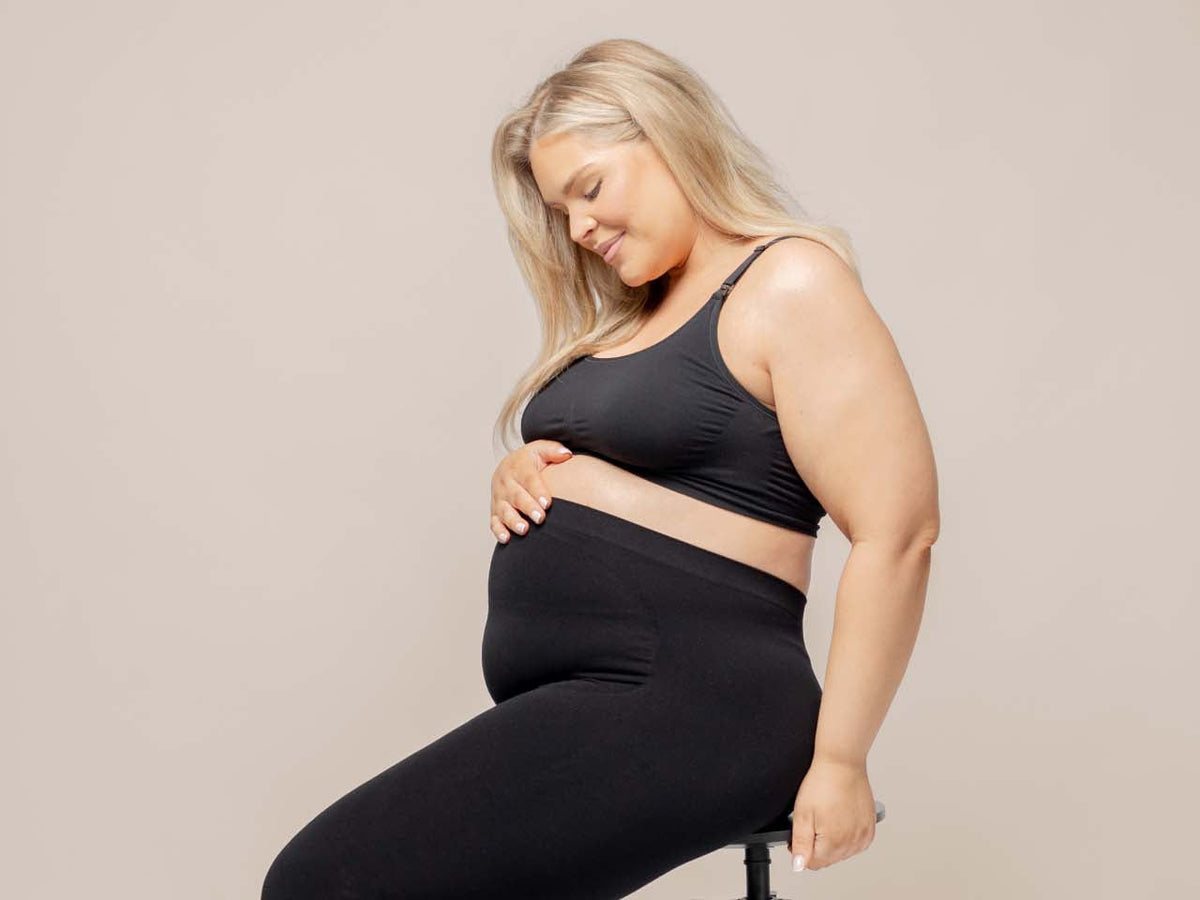
Almost nothing, yet. Sore, bigger breasts are one of the NHS's early signs, so if your bra has started to dig in, a soft wire free one that fits is worth having now. If your jeans stopped doing up at 10 weeks, soft leggings with a panel over the tummy will see you through. The belt, the pillow, the pram and the cot can wait for months.
When to start wearing maternity clothes has the full list of what to buy first, and when do you start showing explains why the jeans go before anything shows.

BABYGO® Maternity Bra
Soft stretch knit in 71% Tencel™ Modal, with no underwire, no hooks and no scratchy tag, so it moves with you as your size changes. The cups unclip one handed, so it carries on as a nursing bra after the birth. True to size, S to XL; between two sizes, take the smaller.
From £22
One reviewer wrote: "Really comfy. Love the colour. Works great for my ever growing boobs".

BABYGO® Activ+ Maternity Leggings
A stretchy panel that comes up over your tummy and stays there, so there's nothing to dig in or roll down, and it keeps stretching right through to the third trimester. S to XXL by dress size, 6 to 18. They run small, so go up one.
From £20
Questions we get asked
Do I need to see a GP when I find out I'm pregnant?
Not usually. The NHS says you can refer yourself straight to a maternity service, and your GP is told after your first midwife appointment. If you have an ongoing health condition or take regular medicine, see a GP or your specialist as soon as possible as well.
Is it too late to book a midwife at 12 weeks?
No. The NHS says that if you're more than 10 weeks pregnant, you should still refer yourself and start your care as soon as possible.
Is it OK that I drank before I knew I was pregnant?
Stop now, and try not to panic. The NHS says the risk of your baby being affected is likely to be low, and not to worry unnecessarily. If it's on your mind, talk to your midwife or GP.
What should you avoid in the first trimester?
Alcohol, smoking and illegal drugs, and any medicine you haven't checked with a pharmacist, midwife or GP. Don't stop prescribed medicine without asking your doctor. No cod liver oil or vitamin A supplements. The food list is in our foods to avoid post.
Can I stop taking folic acid at 12 weeks?
Yes. The NHS says take it for the first 12 weeks, and carrying on for longer won't harm your baby.
Are prescriptions free when you're pregnant?
In England, yes, with a maternity exemption certificate (MatEx). The NHS says it gets you free NHS prescriptions and dental treatment while you're pregnant and for 12 months after the birth. Your midwife, GP or health visitor fills in the form, so ask at the booking appointment if nobody mentions it.
Start with the folic acid and the referral. Then put the first day of your last period into the due date calculator, and every week in that table turns into a real date.